
In many villages in northern Portugal, one house still stands out. A brightly coloured façade, azulejo tiles, statues on the roof, sometimes a palm tree in the garden. The old people have a word for it: it is the house do brasileiro, “of the Brazilian”.
This Brazilian was not Brazilian. He was a local boy who had left very young for the other side of the Atlantic, and came back years later with money. He was called the brasileiro de torna-viagem, the “Brazilian of the return journey”. His story, from the 19th century to the first half of the 20th, is also the story of thousands of Portuguese families.
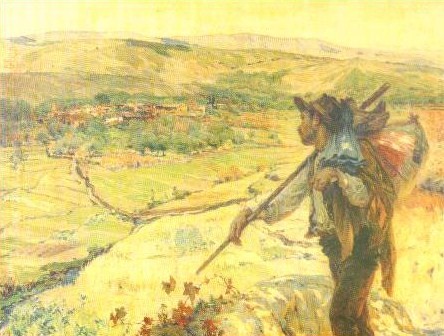
Leaving at fourteen
In the 19th century, north-western Portugal was a land of smallholdings. Families were large and the fields too small for everyone. For many young people, the future seemed to lie almost only in Brazil.
They left early. In Fafe, in the Minho, the historian Miguel Monteiro counted 7,065 direct departures for Brazil between 1834 and 1926. About 30% of those leaving were under 14. About 90% were boys or men. Families often placed their hopes on the eldest son: once settled, he was expected to help his brothers and the parents left at home.
In the village, people dreamed of the árvore das patacas, the “pataca tree”, an imaginary tree on which money grew by itself. The myth of easy Brazil died hard.
Few fortunes, many modest lives
Reality was harsher. An estimate often quoted by historians sums it up: out of a thousand emigrants, about ten made a fortune, about a hundred lived decently, and all the others got by.
Many of those who came back were not rich. Some returned after three or four years with a little capital. The poorest, who had left under contract as farm workers, rarely came back. And anyone who returned empty-handed was not spared: he was nicknamed the brasileiro de mão-furada, the “Brazilian with a hole in his hand”.
The movement did not slow down until the 20th century. In 1912, official Portuguese statistics recorded 88,929 emigrants, not counting clandestine departures.
The “casa de brasileiro”: success for all to see
Those who had succeeded wanted it known. From the second half of the 19th century to the first quarter of the 20th, they built houses that changed the landscape of the Minho, the Douro Litoral and the Beira Litoral.
Historians find the same signs in them: brightly coloured façades, colourful azulejos, statues crowning roofs and gateways, very steep roofs. On some façades, the flags of Portugal and Brazil stand side by side. Palm trees were planted in the gardens, a reminder of the tropics.
Inside, rich furniture, English porcelain, postcards of Brazil on the walls. Sometimes a piano, furniture in Brazilian wood. But not all these houses were palaces. Some remained plain. Others were just the old family house, enlarged and renovated.
A casa de brasileiro was not only a place to live. It told the village: the one who left poor has come back as somebody.
Schools, hospitals, gardens: the village transformed
The richest were also expected to give. They funded schools, hospitals, asylums, brotherhoods and Misericórdias. In return they received honours, sometimes the title of baron or viscount.
Fafe is the most striking example. In 1858, emigrants from Fafe living in Rio de Janeiro formed a committee to build their town’s São José hospital. There followed a Conde de Ferreira school (1866), the Deolinda Leite school (1892), the public garden (1892), theatres, the volunteer fire brigade (1890) and spinning mills (1873 and 1886). The railway arrived in 1907, electricity in 1913. Today the town has a museum devoted to this history, the Museu das Migrações e das Comunidades.
The most famous donor remains the Conde de Ferreira. Joaquim Ferreira dos Santos was born in 1782 in Vila Meã, near Porto. He made his fortune in Brazil, partly through the slave trade: that must be said. Back in Portugal in 1832, he became a baron in 1842, then a count in 1850. On his death, in 1866, his will funded the country’s first psychiatric hospital and a network of 120 primary schools, the “escolas Conde de Ferreira”.
The village’s gaze… and Camilo’s pen
In the village, people looked at him two ways. They admired the benefactor and mocked the upstart. They argued over whether the man asking for a title had given enough. They also poked fun at the abrasileirados, those who played the Brazilian without the means to do so.
Literature fixed this character for good. Camilo Castelo Branco made him a staple of his novels. In Os Brilhantes do Brasileiro (1869), the fat, sweating Hermenegildo Fialho Barrosas embodies the cliché. In Eusébio Macário (1879), Bento comes home and sets tongues wagging: a craftsman is outraged to see him wearing “armas reais em anel”, royal arms on a ring. Greed, gluttony, vanity, lack of education: Camilo shows no mercy. Some scholars point out, however, that his humour also lets him show how varied these men were.
Camilo may have had his reasons. Ana Plácido, the woman he loved, had married Manuel Pinheiro Alves, a rich brasileiro who had become a merchant in Porto. Accused of adultery, Camilo and Ana were imprisoned in Porto’s Relação jail in 1860-1861. The husband is said to have inspired several of the writer’s unpleasant characters.
Other writers joined in. In 1886, Eça de Queirós mocked the novelistic cliché of the Brazilian as “crasso, glutão, manhoso”: coarse, gluttonous, cunning.
An ancestor who left for Brazil
Behind the mansions and the novels, there were above all ordinary families. A boy who left at fourteen. Letters, sometimes money sent home. A return, years later. Or a final silence.
In families from northern Portugal, the phrase comes up again and again: “he went to Brazil”. Perhaps the ancestor came back rich and built the big house in the village. Perhaps he came back modestly, after a few years. Perhaps he stayed there and founded another family. Each of these paths leaves a trace: a tiled house, a school, a name on a plaque, or simply an absence in the tree.
These departures for Brazil are the direct ancestors of the 20th-century departures for France and North America. Leaving to support the family, coming back to build in the village: the gesture is the same.
Do you have an ancestor who left for Brazil, came back rich, came back modestly or never came back? Write to me: the first exchange is free.
Would you like to find your own Portuguese ancestors? Your Portuguese lineage over 4 generations.
Sources
- Museu das Migrações e das Comunidades (Fafe) – Os brasileiros de torna-viagem
- Miguel Monteiro, Universidade do Porto – O Museu da Emigração e os « Brasileiros » do Rio (2007)
- Jorge Fernandes Alves, CEPESE / Universidade do Porto – O « brasileiro » oitocentista: representações de um tipo social
- Alda Neto, CEPESE – As Casas de Brasileiros: movimentos migratórios no Norte de Portugal (2016)
- Universidade Federal de Pelotas – Macedo & Chaves, arquitetura dos brasileiros de torna-viagem (2021)
- J. C. Meneses Rodrigues, FLUP – O património edificado dos brasileiros em Fafe (2021)
- Maria Aparecida Ribeiro, Universidade de Coimbra – Construindo o « Brasileiro » (2007)
- Nau Literária (UFRGS) – O brasileiro torna-viagem na ficção camiliana (2014)
- Universidade de Coimbra, CEIS20 – Joaquim, o Conde de Ferreira e o seu legado
- Direção Regional de Cultura do Centro – Estátua do Conde de Ferreira
- Revista Artemis (UFPB) – Ana Plácido: uma mulher à frente do seu tempo
- Sábado – 200 anos depois, quem é Camilo Castelo Branco?