
In a death register, the entries are usually spaced out. An old man in January, a child in spring, a woman who died in childbirth in autumn. And then, suddenly, everything speeds up. A whole page, then another, filled in a few weeks. The same surnames keep coming back. Children, many children. The priest shortens his formulas; he no longer has the time.
The genealogist understands before even opening a history book: an epidemic has passed through.
What the priest wrote
In the 18th century, a Portuguese death record is often brief. It gives the name of the deceased, the date, a relative (husband or wife, or the parents for a child), and almost always the sacraments. The same formula recurs: faleceu da vida presente com todos os sacramentos, “departed this present life with all the sacraments”.
When the sacraments are missing, the priest explains why. In Coimbra, in September 1765, he notes that a certain João Francisco died “sem sacramentos”, because no one had called him in time. A sudden death, an accident, an illness that was too quick: these few words are often the only clues to the cause of death. For the illness itself is almost never named.
The record also says where the person was buried. Parishioners wanted to rest in their church, beneath the floor. The poor, beggars and children usually went to the adro, the churchyard in front of the church. And for penniless families, the Misericórdia paid for a burial “por amor de Deus”, for the love of God.
So how can you see an epidemic if no one writes it down? By the rhythm. When the deaths of a single month equal those of an ordinary year, the register speaks in its own way.
The “anjinhos”
The first to die were the children. Those under seven, considered free of sin, were called anjinhos, little angels. In some registers their deaths were not even recorded carefully, and you have to guess at their passing.
A study of the parishes of Coimbra shows this clearly. In 1775, a year of high summer mortality, more than one in two infants died there. Portugal also suffered two major general crises in the 18th century, in 1753 and 1762, the latter linked to typhoid fevers.
When you find three children of the same family in your tree who died in the same year, it is almost never a coincidence.
1833: cholera
In the 19th century, a new disease arrived: cholera. It entered Portugal in 1833, during the siege of Porto, in the middle of the civil war between liberals and absolutists. It then spread through the country and killed about 40,000 people, more than the war itself.
Cholera killed quickly, in a few hours or days. In the registers, this shows as families struck all at once, records written in haste, and burial grounds overflowing: in Porto, during the siege, people no longer knew where to bury the dead. Two years later, in 1835, Portugal officially created public cemeteries, away from the churches.
1857: yellow fever in Lisbon
In 1857, yellow fever struck Lisbon. The epidemic peaked in October and only died out in January 1858. About 18,000 people fell ill and 5,652 died, roughly 4% of the city’s population. The low-lying parishes near the river were the worst affected: we now know the mosquito found ideal conditions there.
If your ancestors lived in Lisbon at that time, their parish registers for the autumn of 1857 are likely to be much thicker than usual.
1918: the pneumónica
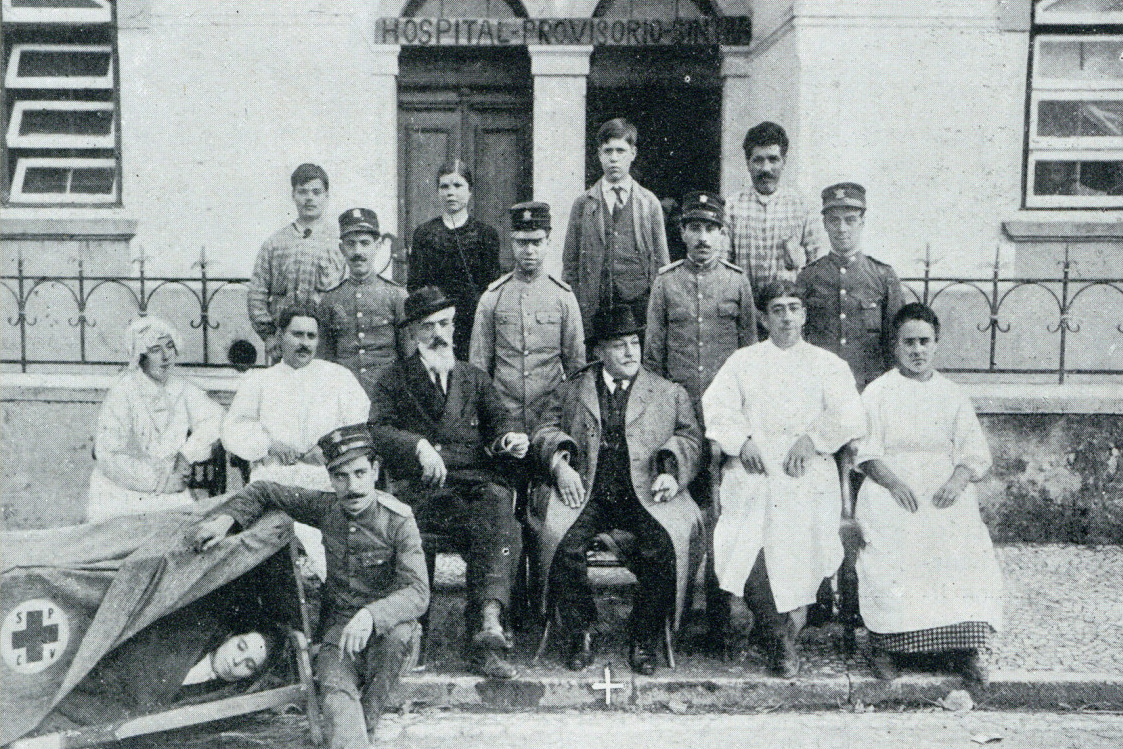
The deadliest in living family memory remains the 1918 flu, which the Portuguese call the pneumónica. The first death was reported in Vila Viçosa, in the Alentejo, at the end of May 1918. A first wave passed during the summer. The second, from autumn until January 1919, was the most terrible. Officially it caused more than 60,000 deaths in Portugal.
The country’s death rate leapt: 40 deaths per thousand inhabitants in 1918, against 21 the year before. And the disease had a cruel feature: it killed mostly young adults. At the hospital in Monção, of 63 patients whose age is known, 33 were between 20 and 40.
Coffins ran short. Some families bought them in advance and kept them under the bed where their loved ones lay dying. In one family, grandparents lost “quatro filhos em cinco dias”, four children in five days.
Note for this period: since 1911, deaths have been recorded in the civil registry, the registo civil, and no longer only by the priest. So it is in the registers of the conservatória, today often kept in the district archives, that you see the pages of autumn 1918 fill up.
What these pages explain in your tree
Epidemics leave traces well beyond the list of the dead. They often explain what seems strange in a family history:
- a widower who remarries only a few months after his wife’s death, with young children to raise;
- orphans raised by grandparents, uncles or godparents;
- a child given the same first name as a brother or sister who died shortly before, a common practice in many European countries;
- a line that dies out all at once, a house that changes hands.
Reading a death register is not just counting the dead. It is understanding what your ancestors went through, and why some of them survived.
Have you spotted a dark year in your family’s registers? Write to me: the first exchange is free.
Do you have an old family record you cannot read? I can transcribe and translate it: Reading and translating an old Portuguese record.
Sources
- Revista Portuguesa de História (Universidade de Coimbra) – registos de óbito de Coimbra, 1750-1777 (PDF)
- ISCTE – As epidemias de cólera em Portugal (1833-1975)
- Significant Cemeteries – Prado do Repouso (Porto): a cólera de 1833 e os cemitérios públicos de 1835
- IHMT, Universidade Nova de Lisboa – a epidemia de febre amarela de Lisboa (1857)
- Diário de Notícias – «A epidemia que veio de Espanha e matou mais de 60 mil portugueses»
- Universidade do Minho – «O impacto da pneumónica em alguns concelhos do Alto Minho» (PDF)
- Genealogy Tip of the Day – «They might have used that name twice»
- Wikimedia Commons – Ilustração Portugueza, 23/12/1918 (domínio público)