In my family tree, one branch stops dead. On the baptism record of his son, in 1895, my great-grandfather has neither father nor mother. Just one word, written by the priest: exposto. Foundling. Behind that word lies a story that tens of thousands of Portuguese families share without knowing it: the story of the roda.
A wheel in the wall
The roda was first of all an object: a revolving wooden cylinder set into the wall of an institution, in Lisbon that of the Santa Casa da Misericórdia, responsible since 1543 for taking in abandoned children. The newborn was placed in the wheel from the street. The cylinder was turned and a little bell was rung. On the other side of the wall, someone took the child in. No one had seen who brought it.
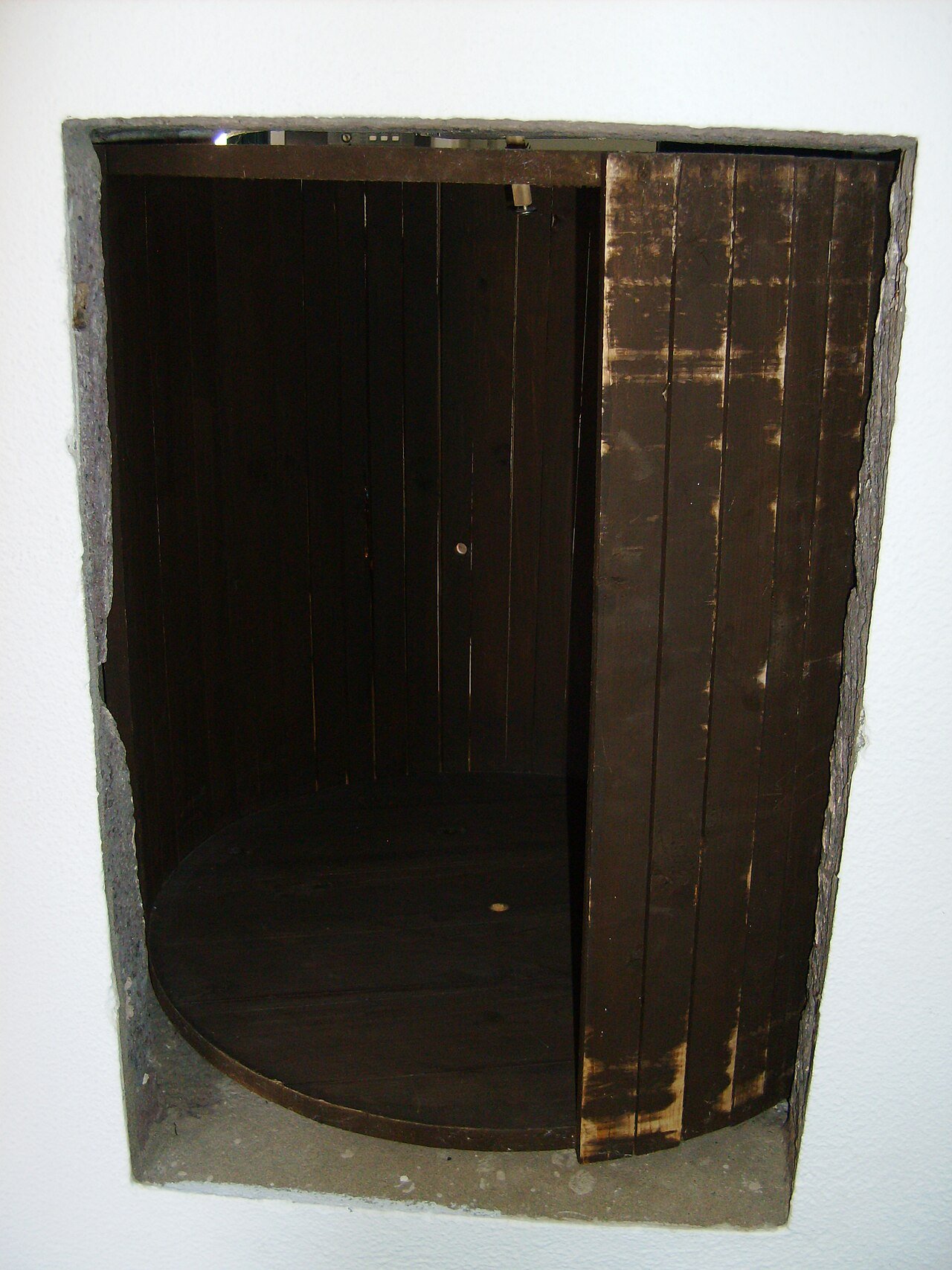
This anonymity was intended. It protected single mothers, families too poor to feed another child, births that had to be hidden. It also protected the child: better the roda than the street.
Before the roda: the children of the Câmara
Long before wheels were set into walls, Portugal cared for its abandoned children. From 1504, the municipalities, the câmaras, were required to pay for their upkeep, through a tax levied on the inhabitants. In the large towns, they handed this task to the Misericórdias, the charitable brotherhoods whose first, in Lisbon, was founded in 1498. The câmaras nevertheless kept paying.
For nearly three centuries, caring for foundlings remained the business of each town, with its own means and customs. In the countryside, a child was often left at the door of a church, a convent or a house known for its charity.
1783: a roda in every town
The turning point came at the end of the 18th century. On 24 May 1783, Diogo Inácio de Pina Manique, the kingdom’s intendant general of police, sent a circular to the whole country. He ordered every town and village to have a place where a child could be left without being seen, with someone ready to receive it at any hour of the day or night. Baptism and nursing were to be paid for by the câmaras.
His aim was to prevent infanticide and to save children in a country short of hands. In practice, the circular organised anonymous abandonment and made it legal. Rodas then multiplied all over Portugal, and with them the number of expostos.
The path of an exposto
When a child arrived through the roda, a sequence of steps began, always the same. The child was first baptised, then entered in a large register, the livro de matrícula dos expostos: the hour, day, month and year of arrival, the child’s condition, and everything found with it. If a note came with the baby, it was attached to the page or copied word for word.
The child was given a number. In some towns, this number was engraved on a small lead medal hung around its neck, with the emblem of the Misericórdia or the Câmara on the back. For a long time, it was the child’s only proof of identity.
Then came the wet nurses. Resident nurses, housed on the premises, fed the newborns as soon as they arrived. The child was then sent to an outside nurse, often in the countryside: first an ama de leite to breastfeed, then an ama de seco for the early years. She was paid every month, and the register recorded her wages, the age until which she was to nurse the child, and the condition in which it had been handed to her.
At around seven, the child was placed with a family who taught it a trade. It became free at around eighteen. Many stayed in their nurse’s village, married there and put down roots. It is often there, far from the town where they had been left, that their descendants are found.
Thousands of children every year
Abandonment had always existed, but from the 18th century it took on considerable proportions. In the 19th century, the Lisbon roda took in several thousand children a year. Very few were ever reclaimed by their parents. Those who could do so had in fact to repay the costs of nursing and upbringing.
It must also be said: many expostos did not survive. They often arrived already weak, sometimes after hours on the road. Disease did the rest: diarrhoea, smallpox, measles, diphtheria. In Évora, in the first half of the 19th century, nearly eight children in ten died. When you find an exposto in your tree, you are also looking at a survivor.
The “sinais”: a note, a ribbon, a medal
Mothers often slipped something in with the child: a sinal, a sign. A short note, a ribbon, a medal, a picture of a saint, a prayer, sometimes a string of beads. This sign was meant, one day, to allow the child to be recognised and taken back.
Notes sometimes gave the date and hour of birth, the name the mother hoped for, or the names of the godparents she would have liked. At other times, the mother cut an object in two, a ribbon, a medal, a coin, a playing card, and kept the other half. If she came back, the two pieces were to match.
Some of these notes are heartbreaking. In 1794, a mother asks that her daughter be named Brízida, and that she be given to a nurse who will treat her well. Two lines, and a whole life held in suspense.
The Santa Casa da Misericórdia de Lisboa still keeps about 90,000 of these signs, dated 1658 to 1939. Some have been exhibited at the São Roque Museum, and the collection has been put forward for UNESCO’s Memory of the World register.
The end of the roda
In the 19th century, the system came under growing criticism: too many children abandoned, too many dying with their nurses. An 1867 decree abolished the rodas, before being reversed a few months later. The districts then closed them one by one. In Lisbon, a hospice with controlled admission opened in 1870: from then on, you had to come in person and give a reason. In 1888, a new decree abolished the rodas throughout the country.
Instead, poor mothers were helped to keep their child, with a small allowance. Abandonments fell sharply. The câmaras remained responsible for the children taken in until the age of seven.
What the archives have kept
The rodas have gone, but their papers remain. In the archives of the Misericórdias, the municipalities and the districts, the admission registers of the expostos, the nurses’ accounts and the notes left by mothers are still waiting. In Sousel, in the Alentejo, for example, the municipal archives keep the termos de apresentação from 1884 to 1915: the date the child was found, its sex, its condition, its clothes, and the name of the nurse who raised it.
In the parish registers, the child appears under the words exposto or exposta, sometimes filho de pais incógnitos, son of unknown parents. A dry, almost administrative line. And yet, behind each one, there is a mother, a night, a roda, and a child who grew up.
When you find “exposto” in your tree
For a genealogist, this word is often a door closing: the parents are unknown, the line stops. But it also tells you something. It says that a woman, one day, had no other choice. It says that a child grew up among strangers, learned a trade, founded a family, and that you are here today because of them.
If you find this word in your family’s records, you are not alone: the expostos number in the hundreds of thousands in Portugal’s history. And sometimes, a register, a sinal or a name given by the roda can still help you understand where they came from.
I came across this story while tracing my own family. If you would like to discover yours, write to me: the first exchange is free.
Sources
- Santa Casa da Misericórdia de Lisboa, Arquivo Histórico – Sinais de Expostos
- Santa Casa da Misericórdia de Lisboa – catálogo «Sinais de Expostos. Exposição histórico-documental» (PDF)
- Observador (14/11/2025) – Santa Casa de Lisboa candidata arquivo com 90 mil sinais da Roda dos Expostos à UNESCO
- Câmara Municipal de Évora – «A exposição de crianças em Évora no século XIX» (PDF)
- Câmara Municipal de Sousel – documentação sobre os expostos no Arquivo Municipal
- Infopédia – Roda dos enjeitados
- Universidade Nova de Lisboa – o abandono de crianças em Lisboa, 1850-1910
- Arquivo Distrital de Santarém – «Os expostos de Santarém e os seus nomes» (2024)
- Wikimedia Commons – Roda dos expostos, Vila do Porto (domínio público)